

Every virus is extremely different. Each has its own properties, lifespan, and mode of transmission. However, they affect extremely similar populations.
Who, you may wonder?
Black people, Native Americans, Latinx people, LGBTQ+ people, migrants, people with low income, people experiencing homelessness, and people who are incarcerated. A viral underclass, if you will.
But how is this viral underclass created, you may wonder?
The -isms: racism, ableism, sexism, heterosexism, nativism, anti-Semitism, and capitalism.
The following formula can help visualize this phenomena:

An infectious disease such as HIV [or COVID or H1N1 or HCV] + Discrimination such as racism [or ableism, sexism, or capitalism] = A Viral Underclass
As two separate entities, I have always been intrigued by infectious diseases and by health equity.
For years, I never considered the intersection between them. Steven Thrasher’s The Viral Underclass does a deep-dive into just that.
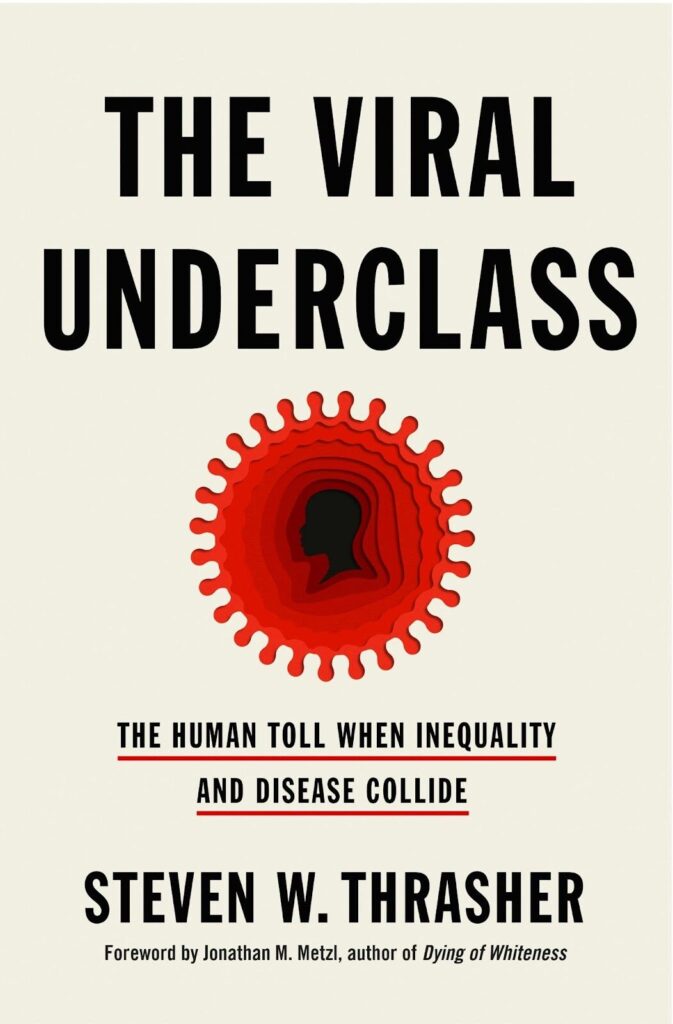
Keep reading to learn more about the book itself, how it relates to equity, and what I plan to do with this framework!
Summary of The Viral Underclass
Keep reading to learn more about the book itself, how it relates to equity, and what I plan to do with this framework!
This book identifies twelve social vectors that contribute to the production of a viral underclass:
- Racism
- Individualized shame
- Capitalism
- The law
- Austerity
- Borders
- The liberal carceral state
- Unequal prophylaxis
- Ableism
- Speciesism
- The myth of white immunity
- Collective punishment
*Let us know if you are interested in learning more about each of these individual vectors. We can create another blog exploring each one in-depth!
Some of these vectors may produce the conditions for unequal viral transmission, or they may intangibly lead to compounding harm. Essentially, some vectors have a direct effect on the viral underclass, while some may be more indirect.
Each chapter dives deeply into different mechanisms that affect the viral underclass, how the mechanism came to exist, and what is contributing to the longevity of each aspect.
Bigger Picture
The entirety of this book relates back to health equity.
Dr. Thrasher writes specifically within the context of how these social vectors affect health equity. He calls upon everyone–general communities–to take a stand for change, not just lawmakers, people in authority, and oppressors. He also does not blame one political party; he critiques both conservatives and liberals for their complicity in creating a system that burdens the viral underclass.
Dr. Thrasher tells some hard truths that some may not want to hear; I know I heard some I didn’t want to. For example, I really had to check some of my biases that I didn’t recognize at first. However, he does it for the sake of the viral underclass. The people that have been undermined, mistreated, and left vulnerable their entire lives.
The Viral Underclass aims to remind us that statistics that we hear so often about, such as mortality rates, are measures of real human lives. They are people who have friends & families, people they love, passions, jobs, etc. He humanizes the individuals who have been “dealt society’s worst hand”.
The perspective that Dr. Thrasher offers toward equity is a unique one. I highly recommend this to those interested in expanding their perspective on health equity.
The Viral Underclass Blog Series
Ever since reading this book about a year ago, I have been deeply inspired by it.
Similar to how The Viral Underclass analyzed the intersection between infectious disease and underserved populations, I have decided to create a blog series that will do the same. As emphasized throughout the book, viruses themselves may not discriminate via the biological mechanism by which they infect individuals, but the systems present in the United States (and the world) will exacerbate the effects of these viruses.
Using a framework similar to Dr. Thrasher’s, I plan to explore the ways in which infectious diseases disproportionately affect society’s most vulnerable and identify potential solutions in eliminating systemic barriers.
I hope you enjoy this series, as I look forward to sharing my findings!
Final Note & About the Author
If you are willing to learn, step out of your comfort zone, and consider new perspectives, I could not recommend this book more. For those interested in reading, you can purchase it here.
Steven Thrasher, PhD is the inaugural Daniel H. Renberg Chair of social justice in reporting and an assistant professor of journalism at Northwestern University. Considered a scholar of the criminalization of HIV/AIDs, his research areas include U.S. Civil Rights, international histories of LGBTQ and gender identities, social movements, court reporting, media frames, colonialism, critical race theory, queer methods, policing, art criticism, public health reporting, and HIV/AIDS history.