
Introduction
Measles, a vaccine-preventable, highly contagious, and once eradicated infectious disease in the United States, has resurged in our schools, communities, and country.
The cause of this resurgence is completely preventable.
Measles reentering our ecosystems is extremely dangerous for everyone, but specifically to the viral underclass – a term coined by Steven Thrasher.
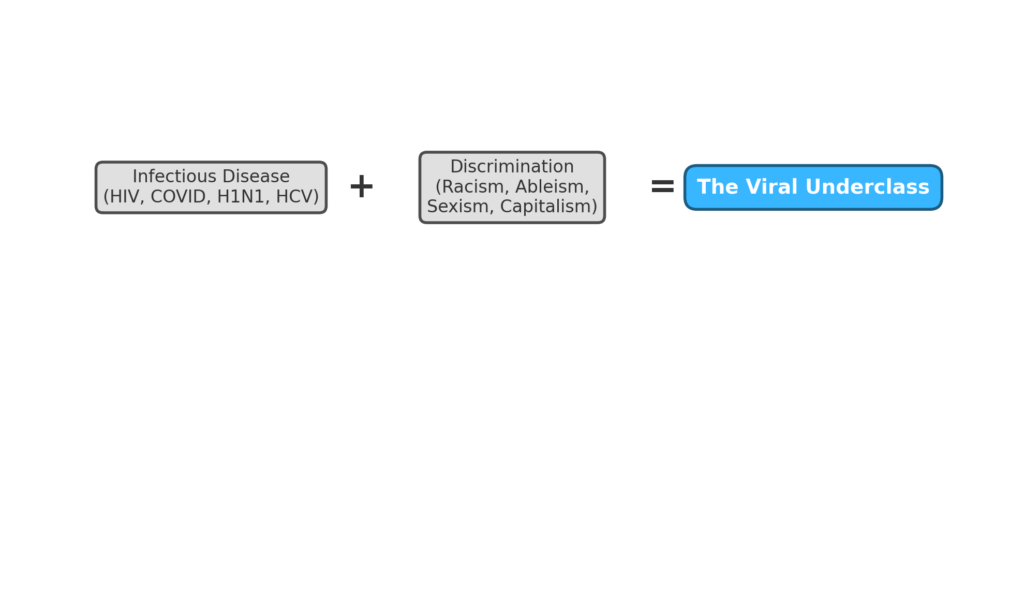
The term ‘Viral Underclass’ describes people and communities who are systematically placed at higher risk of infectious disease – not because of who they are, but because of how resources, protections, and power are distributed.
Examples of those belonging to the Viral Underclass include Black people, Native Americans, Latinx people, LGBTQ+ people, migrants, people with low income, people experiencing homelessness, and people who are incarcerated.
The following formula can help visualize this phenomena:
How do we address why infectious diseases disproportionately affect society’s most vulnerable?
This series will answer that question and further our understanding of the intersection between infectious diseases and health equity.
Today, we delve into a deep analysis of measles.
Let’s better understand the history of measles eradication, what has lent to new outbreaks, who is being affected by these outbreaks, and what can be done to prevent the Viral Underclass from being disproportionately affected.
Measles: What It Is and Why It Spreads So Easily
What is Measles?
Measles is one of–if not–the most contagious infectious diseases.
Measles is a respiratory disease that lives in the nose and throat phlegm of the infected. It is spread via breathing, coughing, and sneezing. When an individual coughs, sneezes, or talks, infected droplets can remain in the air of a room for several hours. A non-immune individual can become infected by just entering the room, hours after the infected person has left.
It is so contagious that 90% of non-immune individuals will be infected if they are in close proximity to someone infected.
R0–called R-nought–measures a diseases’ reproductive value or how much it will spread. It estimates how easily a disease spreads by measuring how many people, on average, one sick person infects. For example, an R0 of 2 means that 1 infected person will infect 2 people. Measles’ R0 value is between 12 and 18. In other words, extremely contagious.
Measles can infect anyone, but it is most common in children.
Symptoms of measles include fever, cough, runny nose, eye irritation, and rash. Severe symptoms include pneumonia, seizures, brain damage, and even death.
There is no antiviral cure for measles. Vaccination is the only protection.
History of Pre-Vaccine Measles (The Cost of Unprotected Populations)
Measles is thought to have originated in cattle. While the emergence date remains unclear, some believe measles arose as early as 6th century BCE, coinciding with the rise of large cities.
The first known differentiation between smallpox and measles dates back to the 9th century from Persian physician, Rhazes, who highlighted the characteristic rash and respiratory symptoms that distinguish measles.
Given what is known about measles high infectivity and that it arose with the rise of large cities, it is no surprise it spread as our world advanced. Measles became especially deadly as it was introduced to immunologically naive populations through colonialism.
Before the measles vaccine was introduced and widespread, major epidemics happened every few years. Measles caused an estimated 2.6 million deaths each year.
Post-Vaccine Measles (Vaccinations as a Public Health Success)
The modern understanding of measles in the 20th century led to great scientific and public health achievements.
In 1963, the first measles vaccine was developed.
The MMR vaccine was introduced in 1971, which protects against measles, mumps, and rubella.
The two-dose MMR vaccine was adopted in 1989. The first dose is usually given at 9 months of age. A second dose should be given later in childhood, usually at 15–18 months. One dose is 93% effective against measles, while two doses is 97% effective at preventing measles.
Widespread vaccination coverage significantly reduced cases of measles, as it is the best preventive measure.
Successful worldwide immunization efforts have prevented an estimated 59 million measles deaths between 2000 and 2024.
Why Measles is Reappearing in the U.S.
What has caused an increase in measles?
In 2025, a total of 2,255 confirmed measles cases were reported in the United States.
Measles was declared eradicated in the United States in 2000. In 2025, the United States had the most cases of measles since that declaration.
Why?
Lapses in vaccination coverage – due to vaccine hesitancy and limited access (more on that soon) – have led to the resurgence of measles.
Vaccine hesitancy, which is heavily influenced by a faulty and retracted study done in 1998, has contributed to a resurgence of measles. The study, published by Andrew Wakefield, falsely associated the MMR vaccine with autism in children. Wakefield, himself, disclosed there was financial interest for him to publish this faulty study, and he lost his medical license and the study was retracted.
Although the study was proven to be faulty, its effects linger still today, especially in our polarized social media landscape.
Nationally, measles vaccination rates among children are falling, from 95% in 2019 to 92% in 2023. As of 2026, this rate may be even lower. This fall is aided by changes in administration leadership with the U.S. Secretary of HHS, Robert F. Kennedy Jr., being a vaccine skeptic and sharing this false rhetoric. Vaccine skepticism and hesitancy are unfortunately perpetuated when our supposed public health leaders share misleading and incorrect information regarding vaccines.
People’s lives are at risk, and dangerous narratives like these are going to put society’s most vulnerable at great harm.
Who is Most Exposed (and Why?)
The largest population at risk for becoming infected with measles is unvaccinated children, as they make up the majority of cases. However, who else is at risk and why?
How Structural Racism Shapes Measles Risk
There are disparities in measles vaccine uptake when broken down by race and ethnicity.
Racial/ethnic and socioeconomic status (SES) disparities in vaccine uptake are caused by structural barriers, such as lack of access to vaccinations, prohibitive costs, and/or systemic, policy, and environmental barriers.
A study in Minnesota found that children born to Somali and Ethiopian parents had the lowest rates (33% and 68%, respectively) of on-time MMR vaccination, compared to 88% among Mexican-American children and 85% among white children.
Vaccine uptake is not the only factor that is important to consider when who is at risk. There are also cultural beliefs that may lead to harmful decisions.
Marginalized populations are more likely to hold skeptical beliefs toward vaccines.
Percentage of adults (by race) that say it is “definitely” or “probably true” that the measles vaccine is more dangerous than measles itself:
- 34% Hispanic adults
- 19% Black adults
- 18% White adults
Percentage of adults (by race) that say Vitamin A can prevent measles infection:
- 43% Hispanic adults
- 25% Black adults
- 18% White adults
These beliefs can be harmful, as they may lead to vaccine hesitancy and result in forgoing recommended vaccinations.
There have also been outbreaks among various ethnoreligious groups, such as Mennonite, Orthodox Jewish, and Amish communities. These tight-knit communities tend to have very low vaccination rates, specifically due to religious beliefs, and thus are extremely susceptible to measles.
Exemptions for vaccinations are controversial. However, it sheds a light on the importance of herd immunity. When a critical portion of a community is immunized against a contagious disease, the virus can no longer circulate in the population. If a community has a high enough vaccination rate and is ‘immune’, there may be room for exemptions, especially religious. However, this is generally not the case.
The causes for vaccine hesitancy among minoritized racial and ethnic groups are due to underlying systemic barriers, biases, and can be rooted in cultural norms.
Protecting People with Higher Medical Vulnerability
Individuals who are immunocompromised are particularly vulnerable. If your body’s immune system is already compromised, you may be highly susceptible to a disease as contagious as measles.
Examples of immunocompromised individuals who are at risk include malnourished children, persons who have human immunodeficiency virus (HIV), persons receiving cancer treatment, and pregnant persons.
Those with HIV, who are not vaccinated for measles, are at an especially high risk for more severe infection with pneumonia or encephalitis.
Income, Access, and Exposure
Another key element of identifying risk for measles is socioeconomic status.
Analysis has shown that MMR uptake remains low particularly in counties with disadvantaged socioeconomic profiles.
Socioeconomically weaker sections, often characterized by poverty, inadequate health care access, overcrowding, and suboptimal immunization rates, face heightened risks of measles outbreaks.
On the other hand, it has also been found that households with higher socioeconomic status are more likely to portray vaccine hesitant behaviors, which may also inform how to intervene on this behavior.
Overall, geographic distribution, which is heavily shaped by socioeconomic status, is a strong indicator of vaccine uptake and hesitancy.
Rural Community Gaps
Individuals who live in rural areas, which already have an array of public health-related challenges, are especially at risk for measles outbreaks.
Specifically, rural areas face medical professional shortages, inadequate infrastructure for outbreaks, time/distance/transportation constraints, and barriers for testing and care.
An area like West Texas, where many cases have been reported, does not have the adequate resources and infrastructure to contain a large measles outbreak. For example, one county had to turn their town hall into a testing center to support the large volume of cases. Rural communities often lack the infrastructure, medical personnel, and capacity required to manage outbreaks of highly contagious diseases like measles.
Location matters when considering how a measles outbreak may affect a population. This interactive map allows people to type in their ZIP code and see an estimated percentage of their neighbors who have been vaccinated against measles, which can help determine the risk of the disease in their area.
Upon brief analysis of this map, it can be observed that more rural areas tend to have lower vaccination rates and thus higher risk for a measles outbreak.
Insurance Coverage as a Barrier to Prevention
Most insurance in the United States must cover preventive care services, including the MMR vaccine, under the Affordable Care Act. However, some plans are exempt from this rule.
In Texas, a young boy went to the doctor to receive the MMR vaccine, among others. His family was shocked to see a bill of over $2,500, with the MMR vaccine alone being $1,400. All he wanted was protection for measles and other vaccine-preventable diseases. The insurance coverage the boy’s family had did not cover preventive care.
Families should not have to worry about paying out-of-pocket for essential preventive care, like the measles vaccine, which saves lives.
In terms of insurance coverage type, there is a clear disparity in vaccination rates. For children who have private insurance, 78.4% received recommended vaccines in 2022-2023. While children who were not insured, only 51.9% received recommended vaccinations.
If a family cannot vaccinate their child due to lack of coverage, that gap does not affect just one child. The consequences can extend to the entire community, placing other children, immunocompromised individuals, and entire neighborhoods at risk for measles.
This is why it is essential to have as many people vaccinated as possible.
Equitable Efforts
To eradicate measles, the most effective strategy is to increase vaccination coverage, especially among the populations identified above at the highest risk due to systemic disparities.
But how can this be done?
Identifying the at-risk populations is one of the first steps, then further tailored interventions to increase vaccination rates can be implemented. However, it can be difficult to identify which populations are at risk if data is not effectively broken down.
We need data that is disaggregated further by race and ethnicity, socioeconomic status, and urban/rural status to name a few. Then, we can effectively tailor interventions to serve these communities.
Culturally sensitive and appropriate interventions are also necessary to increase vaccine uptake. For certain ethnoreligious groups, religious leaders may need to become involved, as they are trusted members of their communities. Also, as mentioned earlier, there are systemic and cultural barriers that are the causes for certain racial and ethnic groups to forego vaccines. It is crucial to identify and dismantle these barriers to re-educate.
Not only do we need culturally sensitive interventions, but we also need targeted geographic interventions for serving rural communities, areas of low SES, or other areas experiencing a high volume of cases.
It is extremely important to address the social determinants of health that are affecting these communities’ access to vaccines, attitudes toward vaccines, and vulnerability.
Lower vaccination rates are shaped by access barriers, insurance coverage gaps, historic lack of distrust, geographic constraints, and other failures of our system. They are not due to individual failures in responsibility.
By acknowledging the variables that are putting individuals at a higher risk of measles, we are one step closer to advancing national vaccine equity and disease prevention goals.
Conclusion
With a disease as contagious as measles, one would think that everyone has an ‘equal chance’ to become infected. However, that does not appear to be the case.
The harmful narrative from our nation’s leaders surrounding vaccines, specifically the measles vaccine, is extremely dangerous for society’s most vulnerable: the viral underclass.